LMS
LMS
Last updated on 19th May 2026| 4571

- Introduction to Generative AI Tutorial for Beginners
- Foundations of AI
- Neural Networks Basics
- Generative Models Overview
- GANs and VAEs
- Transformers Explained
- Applications in Text and Images
- Tools and Platforms
- Ethics and Responsible AI
- Conclusion
Introduction to Generative AI Tutorial for Beginners
AI Image Generation is an innovative technology where artificial intelligence systems create unique and realistic images from prompts, patterns, or datasets. Unlike traditional graphic design tools, AI models learn from millions of sample images and generate new visuals automatically. These systems use deep learning and computer vision techniques to understand shapes, textures, colors, and artistic styles in Gen AI Course. AI image generation is widely used in industries such as entertainment, advertising, healthcare, education, gaming, and e-commerce. Beginners can easily explore this field using pre-trained models and beginner-friendly platforms without needing advanced programming knowledge. The technology combines creativity with machine intelligence, allowing users to transform ideas into digital artwork, product designs, and realistic visuals efficiently. Learning AI image generation helps freshers understand modern AI trends and opens career opportunities in machine learning, design automation, and computer vision applications.
Foundations of AI
- Definition: Artificial Intelligence (AI) enables machines to simulate human intelligence by learning from data, recognizing patterns, and making informed decisions. Core AI domains include machine learning, deep learning, natural language processing (NLP), and robotics, powering applications such as chatbots, recommendation systems, and intelligent automation.
- Learning Path: Begin with mathematics, including probability, statistics, and linear algebra, followed by Python programming and machine learning fundamentals. Practice supervised and unsupervised learning techniques, work with real-world datasets, and build small AI projects to strengthen practical skills and technical confidence.
- Evolution: Artificial Intelligence has evolved from rule-based expert systems to advanced deep learning and transformer-based models. Modern AI powers speech recognition, computer vision, autonomous vehicles, virtual assistants, and generative AI applications, demonstrating remarkable progress in intelligent computing.
- Applications: AI is widely used in healthcare for disease diagnosis, retail for personalized recommendations, finance for fraud detection and risk analysis, education for adaptive learning, and logistics for route optimization. Learn more about AI-powered applications through the Google Gemini Tutorial.
- Importance for Freshers: Learning AI builds strong analytical, programming, and problem-solving skills while preparing beginners for internships, industry projects, and careers in artificial intelligence, machine learning, data science, and generative AI. AI expertise also enhances innovation and long-term career growth.
Neural Networks Basics
Neural networks are the foundation of AI image generation and computer vision systems. Inspired by the human brain, they consist of interconnected layers of artificial neurons. Convolutional Neural Networks (CNNs) are especially effective for image processing because they automatically detect patterns such as edges, textures, and shapes in Gen AI Course . Neural networks learn by adjusting weights through training processes like backpropagation and gradient descent. Deep neural networks can classify images, recognize objects, and generate realistic visuals from data. Techniques such as dropout, activation functions, and data augmentation improve performance and prevent overfitting. For freshers, understanding neural networks is essential before exploring advanced generative models like GANs and diffusion systems. These networks transform raw image pixels into meaningful visual understanding and intelligent outputs.
Generative Models Overview
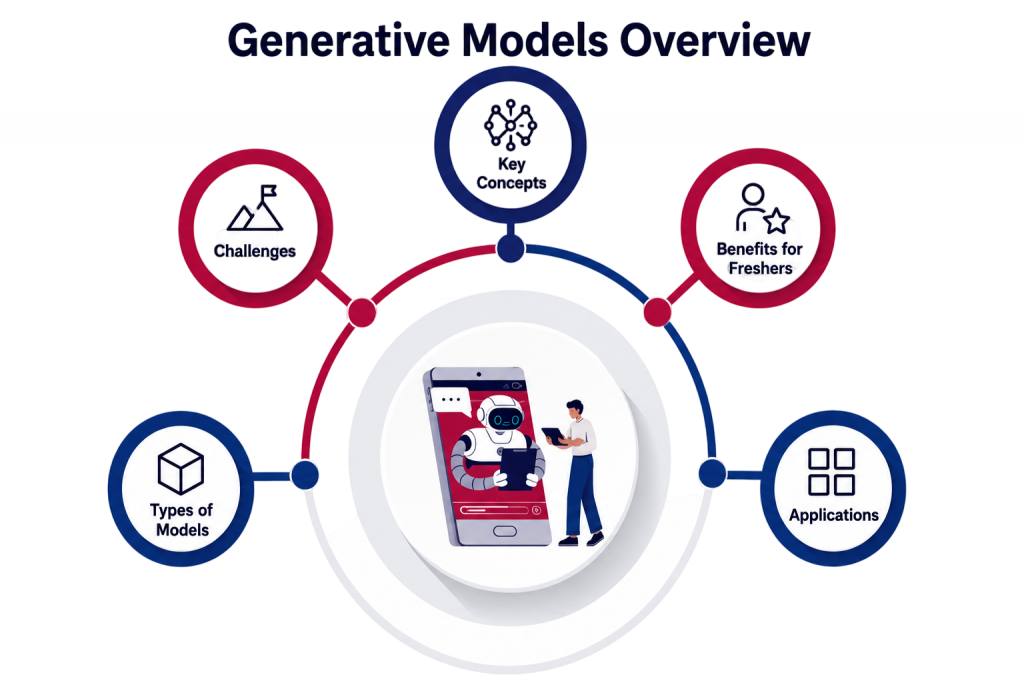
- Types of Models: Generative AI includes Variational Autoencoders (VAEs), Generative Adversarial Networks (GANs), Diffusion Models, and Transformer-based architectures. VAEs learn compressed data representations, GANs generate realistic content through adversarial training, diffusion models produce high-quality outputs by gradually removing noise, and transformers excel at generating text, images, and multimodal content.
- Applications: Generative models are widely used for text-to-image generation, image editing, artistic style transfer, synthetic dataset creation, code generation, content creation, drug discovery, and scientific simulations. Learn more about practical implementations in the Generative AI Step-by-Step Tutorial.
- Key Concepts: Core concepts include latent space representations, embeddings, probability distributions, attention mechanisms, and optimization algorithms that enable AI models to generate realistic, context-aware, and high-quality content while balancing creativity, accuracy, and computational efficiency.
Ready to earn your Gen AI Professional Certification? Discover the Gen AI Course now available at ACTE!
GANs and VAEs
Generative Adversarial Networks (GANs) and Variational Autoencoders (VAEs) are two fundamental generative AI models used for creating realistic images and learning meaningful data representations. GANs consist of two neural networks—a generator that creates synthetic images and a discriminator that distinguishes between real and generated images. Through adversarial training, both networks improve continuously, enabling GANs to produce highly realistic visual content. In contrast, VAEs learn compressed latent representations of data and reconstruct images by sampling from the learned latent space, making them effective for image generation, anomaly detection, and data compression. To understand the core concepts behind these technologies, explore the Generative AI Basics to Advanced Tutorial. GANs are widely used in digital art, gaming, animation, and synthetic data generation, while VAEs are commonly applied in representation learning, image reconstruction, and feature extraction. Learning both architectures helps beginners build a strong foundation in generative AI, deep learning, and computer vision while preparing them for real-world AI development projects.
Get Your Gen AI Certification by Learning from Industry-Leading Experts and Advancing Your Career with ACTE’s Gen AI Course.
Tools and Platforms
- Frameworks: Popular AI frameworks such as TensorFlow, PyTorch, Keras, and Hugging Face provide powerful tools for developing, training, fine-tuning, and deploying machine learning, deep learning, and generative AI models. These frameworks form the foundation of modern AI application development.
- Platforms: Google Colab, Jupyter Notebook, Kaggle, AWS, Microsoft Azure, and Google Cloud Platform (GCP) provide cloud-based environments for AI development, experimentation, and deployment. Learn more about AI fundamentals through the Generative AI Tutorial.
- Utilities: AI development is supported by APIs, preprocessing libraries, visualization tools, model evaluation frameworks, vector databases, and deployment platforms that simplify integration, debugging, monitoring, and production deployment of AI applications.
- Learning Approach: Begin with Google Colab and Jupyter Notebook for hands-on practice, experiment with pre-trained models using Hugging Face, build projects with PyTorch or TensorFlow, and gradually deploy applications on cloud platforms to gain practical experience in real-world AI development.
- Best Practices: Use virtual environments, maintain updated dependencies, document project workflows, implement version control with Git, and create reproducible notebooks to ensure reliable, scalable, and collaborative AI development.

Applications in Text and Images
- Healthcare: AI generates synthetic medical images for research and training, supports disease diagnosis without exposing patient information, and assists medical professionals in treatment planning. These applications improve accuracy and patient care efficiency, motivating freshers with meaningful examples.
- Finance: AI creates synthetic documents for fraud detection and analysis, supports predictive risk management, and automates reporting to improve operational efficiency. It also enhances cybersecurity and transaction monitoring, showing freshers the importance of AI in business sectors.
- Education: AI produces personalized tutoring visuals and educational illustrations, powers adaptive learning systems, and helps institutions create engaging content. Interactive visuals enhance global learning experiences, inspiring innovative projects for beginners and researchers.
- Entertainment: AI generates digital art, animations, and gaming environments. Movie industries use AI for visual effects, while music and media production benefit from generative technologies. These applications increase creativity and audience engagement, encouraging freshers to explore artistic AI possibilities.
- Business: AI automates marketing visuals and advertising campaigns, generates product prototypes, and improves branding and customer engagement. Companies use generative AI for design automation and innovation, boosting productivity and reducing manual work. Freshers gain insight into how AI supports modern business transformation.

Get JOB Oriented Gen AI Training for Beginners By MNC Experts
- Instructor-led Sessions
- Real-life Case Studies
- Assignments
Real-World Use Cases
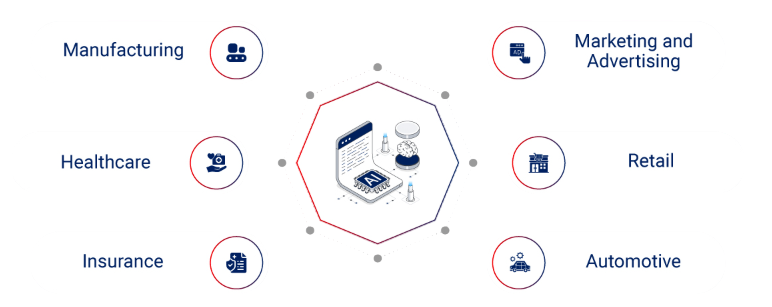
- Healthcare: Generative AI supports healthcare by creating synthetic medical images for research, assisting in disease diagnosis, generating clinical documentation, protecting patient privacy, and improving treatment planning. To understand the deep learning concepts behind these applications, explore the Artificial Neural Network Tutorial.
- Finance: Financial organizations use generative AI for fraud detection, risk assessment, automated report generation, regulatory compliance, customer support, cybersecurity, and intelligent transaction monitoring, helping improve operational efficiency and business decision-making.
- Education: Generative AI creates personalized learning materials, educational illustrations, interactive tutorials, quizzes, and adaptive learning experiences that help students, educators, and researchers improve engagement and knowledge retention through intelligent content generation.
- Entertainment: AI is widely used to generate digital artwork, animations, game assets, visual effects, music, and creative media content. To explore the computer vision technologies behind these applications, visit the Object Detection Tutorial.
- Business: Organizations use generative AI to automate marketing content, product design, advertising campaigns, customer communications, branding, and business documentation, improving productivity, accelerating innovation, and enhancing customer engagement across industries.
Want to Master Gen AI? Explore the Gen AI Master Program Offered at ACTE Today!
Ethics and Responsible AI
- Transparency in AI: AI systems should explain how outputs and decisions are generated. Users must know whether visuals are AI-generated or human-created. Transparency increases trust and accountability in AI applications and helps identify errors for improved reliability.
- Avoiding Bias and Discrimination: Biased training data can produce unfair outputs. Developers must use balanced datasets for fairness and inclusivity. Regular testing reduces discrimination and inaccurate predictions, ensuring equal treatment for diverse user groups.
- Data Privacy and Security: AI systems often require large datasets containing sensitive information. Organizations must protect this data from misuse or leaks through strong encryption and security practices in our Gen AI Course. Users should understand how their information is collected and used.
- Preventing Misuse of AI: AI can be misused for deepfakes and fake content generation. Ethical guidelines and monitoring systems help detect suspicious activities early, ensuring technology benefits society positively and safely.
- Human Supervision and Accountability: AI systems should operate under human monitoring and control. Critical decisions must not rely entirely on automated outputs and Intelligent Apps Tutorial. Human supervision improves reliability and prevents harmful mistakes, while organizations remain accountable for AI-generated consequences.
Want to Learn About AI? Explore Our DevOps Interview Questions and Answers Featuring the Most Frequently Asked Questions in Job Interviews.
Conclusion
Generative AI Tutorial for Beginners is transforming the digital world by enabling machines to create realistic and creative visuals from prompts and datasets. Technologies such as neural networks, GANs, and diffusion models have significantly improved image quality and generation capabilities. These advancements are influencing industries like healthcare, entertainment, education, business, and marketing through automation and intelligent creativity in our Gen AI Course. Although AI image generation provides many opportunities, challenges such as bias, privacy concerns, and misuse require responsible practices and ethical regulations. Freshers entering this field can build strong careers by learning AI fundamentals, experimenting with modern tools, and developing creative projects consistently. With continuous innovation and responsible implementation, AI image generation will continue shaping the future of digital creativity, automation, and intelligent visual communication.